

AM
-
Posts
792 -
Joined
-
Last visited
Content Type
Forums
Events
Store
Video Gallery
Everything posted by AM
-
(loop for i in (gen-divide 2 '(c 4 d 5 e 3 c 6 eb 4)) collect (compress i)) => (c4 d5 e3 c6 eb4) i didn't read you posts precisely. only the last ONE ...but you could use COMPRESS...?
-
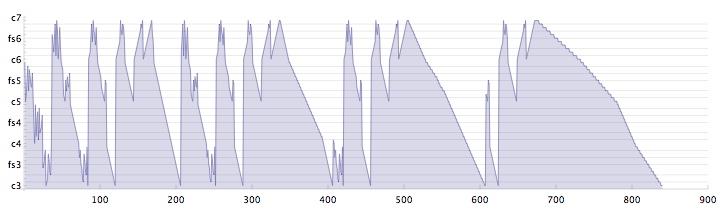
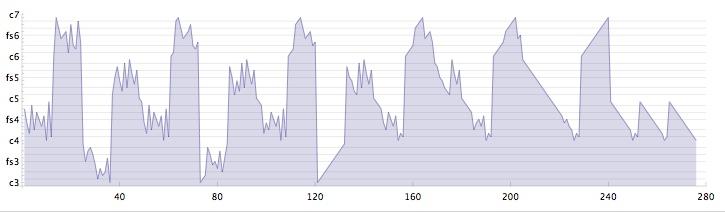
have fun... greetings andré ;;; here is a MULTI-GEN-SORT ------------------------- ;;; you could interlace different processes of SORTING (defun multi-gen-sort (lists &key (types nil) (sorts '>) (steps nil) (seed nil)) (let* ((sorted-lists (loop for i in lists for cnt = 0 then (incf cnt) collect (gen-sort i :type (if (listp types) (nth cnt types) types) :sort (if (listp sorts) (nth cnt sorts) sorts) :step (if (listp steps) (nth cnt steps) steps) :seed seed)))) (flatten (loop repeat (find-max (loop for i in sorted-lists collect (length i))) for cnt = 0 then (incf cnt) collect (loop for i in (reverse sorted-lists) collect (nth cnt i)))))) ;;; some examples (pitch-list-plot (flatten (multi-gen-sort (list (expand-tonality '(c5 'chromatic)) (expand-tonality '(c3 'chromatic)) (expand-tonality '(c4 'chromatic)) (expand-tonality '(c6 'chromatic))) :types '(selection insertion min-max selection) :sorts '(> > > >) :steps '(7 6 7 3))) :join-points t :point-radius 0 :style :fill) (pitch-list-plot (flatten (multi-gen-sort (list (rnd-order (expand-tonality '(c5 'chromatic))) (rnd-order (expand-tonality '(c3 'chromatic))) (rnd-order (expand-tonality '(c6 'chromatic))) (rnd-order (expand-tonality '(c4 'chromatic)))) :types '(insertion selection min-max selection) :sorts '(> < < >) :steps '(5 3 7 nil))) :join-points t :point-radius 0 :style :fill) (pitch-list-plot (flatten (multi-gen-sort (list (rnd-order (expand-tonality '(c6 'chromatic))) (rnd-order (expand-tonality '(c5 'chromatic))) (rnd-order (expand-tonality '(c4 'chromatic))) (rnd-order (expand-tonality '(c3 'chromatic)))) :types '(selection nil insertion min-max) :sorts '(< > < >) :steps '(4 4 4 4))) :join-points t :point-radius 0 :style :fill) (pitch-list-plot (filter-repeat 1 (flatten (multi-gen-sort (list (rnd-order (expand-tonality '(c4 'chromatic))) (rnd-order (expand-tonality '(cs4 'chromatic))) (rnd-order (expand-tonality '(d4 'chromatic))) (rnd-order (expand-tonality '(ds4 'chromatic)))) :types '(insertion selection min-max selection) :sorts '(> < > <) :steps '(5 5 5 5)))) :join-points t :point-radius 0 :style :fill) ;;; a SORT2 :-) (pitch-list-plot (flatten (gen-sort (flatten (multi-gen-sort (list (rnd-order (expand-tonality '(c6 'chromatic))) (rnd-order (expand-tonality '(c5 'chromatic))) (rnd-order (expand-tonality '(c4 'chromatic))) (rnd-order (expand-tonality '(c3 'chromatic)))) :types '(selection nil insertion min-max) :sorts '(< > > >) :steps '(3 3 3 3))) :type 'insertion :step 7 :sort '>)) :join-points t :point-radius 0 :style :fill) some examples: a sorted mulit-gen-sort:
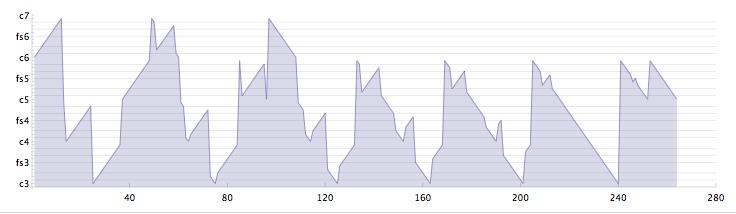
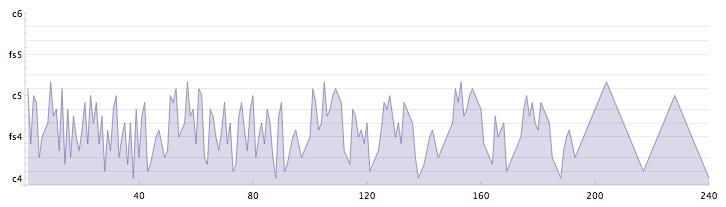
-
you should also share your ideas/thoughts/concepts!!??
-
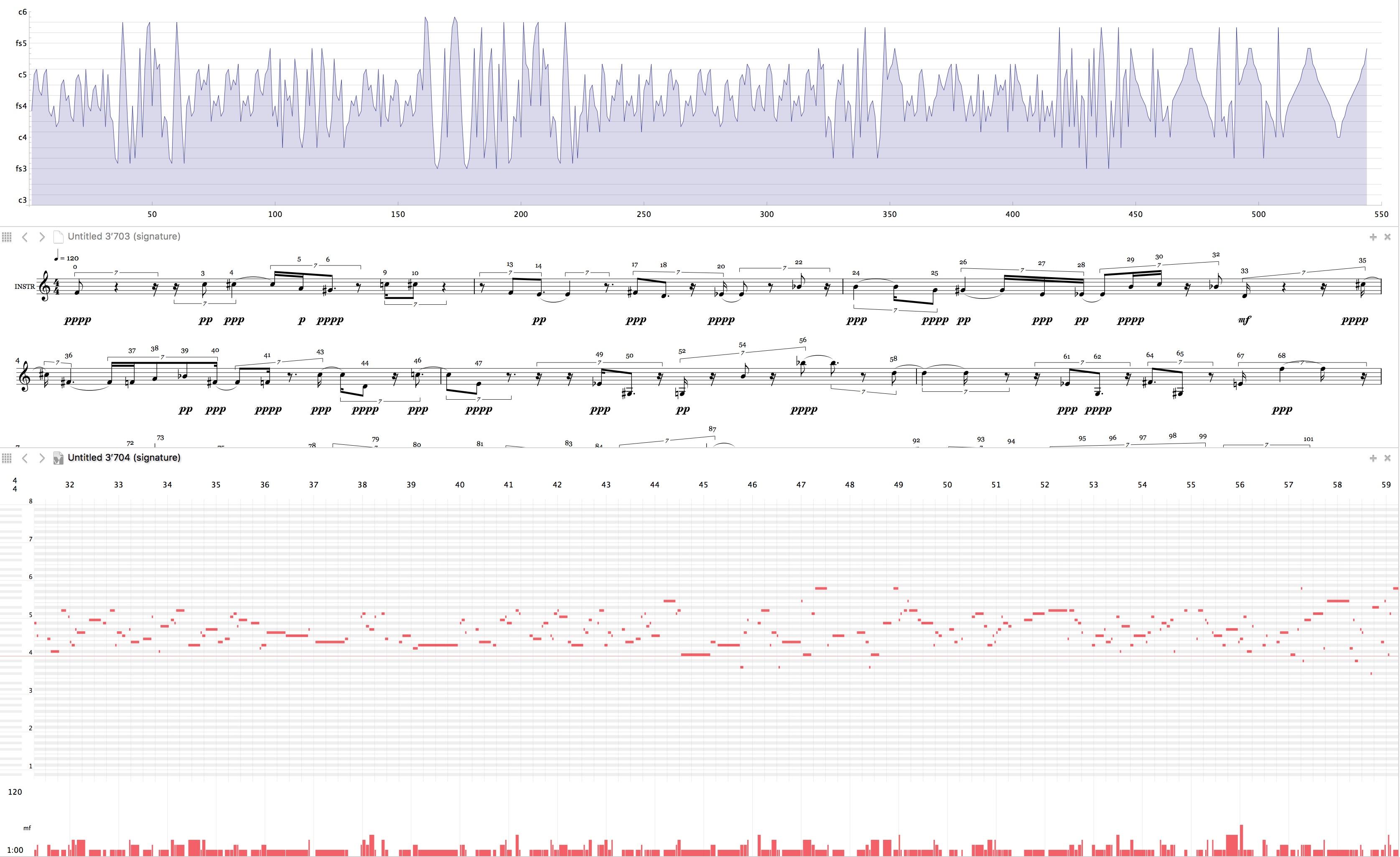
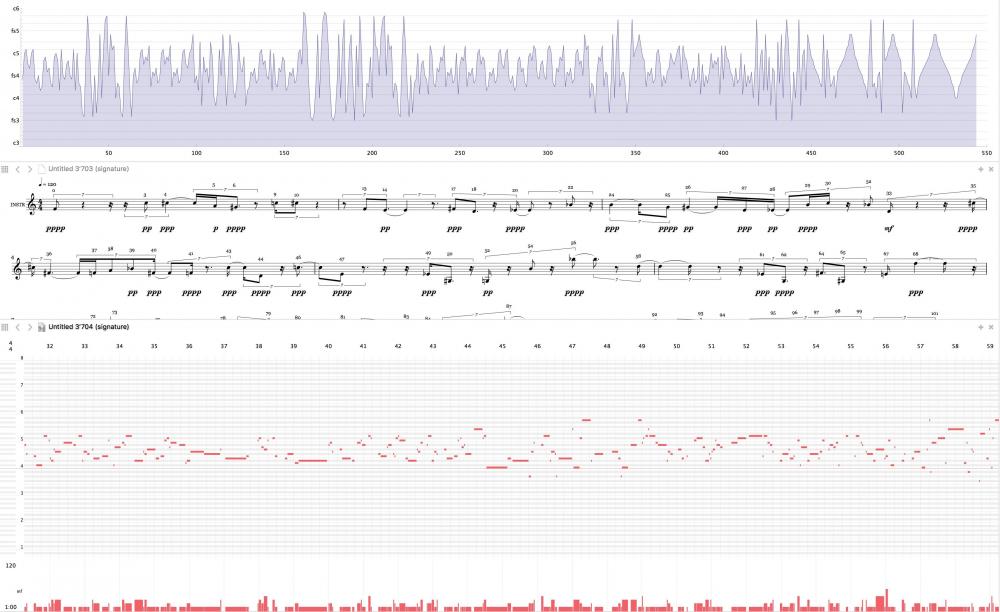
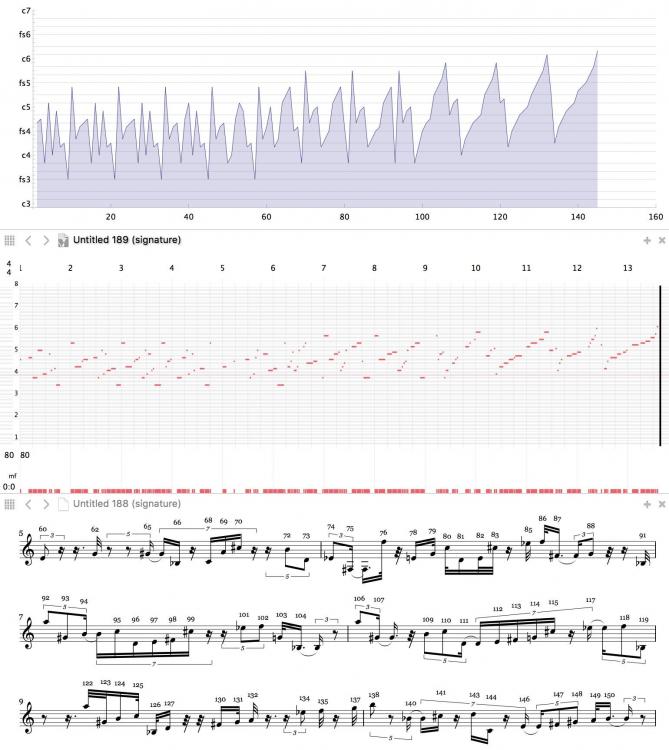
hi julio it's too complicated to share the code...the FUNCTION is made for a specific idea of the work (not common), so it's made for MY need... here is a short sketch of the work... (part of it) a) generating a pitch-sequence => by using a 12-tone-seq + its expansion by a sorting-algorithm (with GEN-SORT) => an INTERVAL-order mutates to a SCALE (see the list-plot) b) pitches are projected on a sequence of symmetrical expanding/compressing FIELDS (with CHORD-CONTR...) => you see how the pitch-seq is contracted/exapnded in "space" - result is a kind of interference of this processes => at the end you see (in list-plot) that the interference is going more and more to ONE LEVEL - to a SCALE - so its a kind of inside/out. the inherent structure, the inherent process/order is more and more recognizable during the process (start with compr/exp. 12-tone-row to the simple SCALE) the project is a bit larger. this sequence (which rhythm is based on a binary-event-filter (data of a jpeg of an artist)) is only the structural background (some ideas developed by LACHENMANN) - on this NET (the score you see) there will be other GESTALTS/MOTIFS etc... because my needs are such specific to my and my idea - most of the functions i had to code for myself, or modify/enlarge the OPMO functions, great that this is possible on this platform. sorry a bit complicated and i can't not describe it properly with a few words
-
BUG is fixed now. should work correct!
-
;;; THIS FUNCTION DOING SYMM TRANSPOSITIONS TO CONRACT (OR EXPAND, depends on INTERVAL) A CHORD or PITCH-SEQ ;;; default setting: it changes in every generation the highest and lowest pitch by an OCTAVE ;;; by changing :position (see examples) you could change which position should be changed/transposed ;;; default interval is 12 ;;; FUNCTION (defun chord-contraction/expansion (n pitchlist &key (position nil) (interval 12) (chord nil)) (let* ((pitchlist (if (chordp (car pitchlist)) (melodize pitchlist) pitchlist)) (position (if (null position) (list 0 (1- (length pitchlist))) (if (listp position) position (list position (- (1- (length pitchlist)) position))))) (pitchlist (cons pitchlist (loop repeat n collect (setf pitchlist (sort-asc (flatten (position-replace position (list (pitch-transpose interval (list (nth (car position) pitchlist))) (pitch-transpose (neg! interval) (list (nth (cadr position) pitchlist)))) pitchlist)))))))) (if (null chord) pitchlist (chordize pitchlist)))) ;;; EXAMPLES: evaluate by cmd3 (setf 12-tone-field '(f3 fs3 gs3 c4 d4 e4 b4 cs5 eb5 g5 a5 bb5)) (chord-contraction/expansion 4 12-tone-field :chord t) => ((f3fs3gs3c4d4e4b4cs5eb5g5a5bb5) (fs3gs3c4d4e4f4bb4b4cs5eb5g5a5) (gs3c4d4e4f4fs4a4bb4b4cs5eb5g5) (c4d4e4f4fs4g4gs4a4bb4b4cs5eb5) (d4eb4e4f4fs4g4gs4a4bb4b4c5cs5)) (chord-contraction/expansion 4 12-tone-field :chord t :interval 48) => ((f3fs3gs3c4d4e4b4cs5eb5g5a5bb5) (bb1fs3gs3c4d4e4b4cs5eb5g5a5f7) (f3fs3gs3c4d4e4b4cs5eb5g5a5bb5) (bb1fs3gs3c4d4e4b4cs5eb5g5a5f7) (f3fs3gs3c4d4e4b4cs5eb5g5a5bb5)) ;;; with spezific positions (inner change) (chord-contraction/expansion 4 12-tone-field :chord t :position 3) => ((f3fs3gs3c4d4e4b4cs5eb5g5a5bb5) (f3fs3gs3d4eb4e4b4c5cs5g5a5bb5) (f3fs3gs3cs4eb4e4b4c5d5g5a5bb5) (f3fs3gs3d4eb4e4b4c5cs5g5a5bb5) (f3fs3gs3cs4eb4e4b4c5d5g5a5bb5)) (chord-contraction/expansion 4 12-tone-field :chord t :position '(0 5)) => ((f3fs3gs3c4d4e4b4cs5eb5g5a5bb5) (e3fs3gs3c4d4f4b4cs5eb5g5a5bb5) (f3fs3gs3c4d4e4b4cs5eb5g5a5bb5) (e3fs3gs3c4d4f4b4cs5eb5g5a5bb5) (f3fs3gs3c4d4e4b4cs5eb5g5a5bb5)) ;;;; with different intervals (chord-contraction/expansion 4 12-tone-field :chord t :interval 11) => ((f3fs3gs3c4d4e4b4cs5eb5g5a5bb5) (fs3gs3c4d4e4e4b4b4cs5eb5g5a5) (gs3c4d4e4e4f4bb4b4b4cs5eb5g5) (c4d4e4e4f4g4gs4bb4b4b4cs5eb5) (d4e4e4e4f4g4gs4bb4b4b4b4cs5)) (chord-contraction/expansion 4 12-tone-field :chord t :interval 7) => ((f3fs3gs3c4d4e4b4cs5eb5g5a5bb5) (fs3gs3c4c4d4e4b4cs5eb5eb5g5a5) (gs3c4c4cs4d4e4b4cs5d5eb5eb5g5) (c4c4cs4d4eb4e4b4c5cs5d5eb5eb5) (c4cs4d4eb4e4g4gs4b4c5cs5d5eb5))
-
often helpful in PATTERN MATCH things... (like in OPMO pattern-match-functions) here is a short IDEA for an octave-independent PITCH-PATTERN-MATCHP with possible WILDCARD, perhaps could help you... ;;;-------------------------------------------------------------- ;;; PITCH PATTERN-MATCHP octave-independent ;;;-------------------------------------------------------------- ;;; SUB (defun convert-pitch (pitches) (loop for i in pitches when (pitchp i) collect (compress (butlast (explode i))) else collect i)) ;;; MAIN (defun pitch-pattern-matchp (pitchlist pattern) (let ((pitchlist (convert-pitch pitchlist)) (pattern (convert-pitch pattern))) (pattern-matchp pitchlist pattern))) (pitch-pattern-matchp '(c4 d4 eb4 f4 g4) '(c ? e)) => nil (pitch-pattern-matchp '(c4 d4 eb4 f4 g4) '(c ? eb)) => t
-
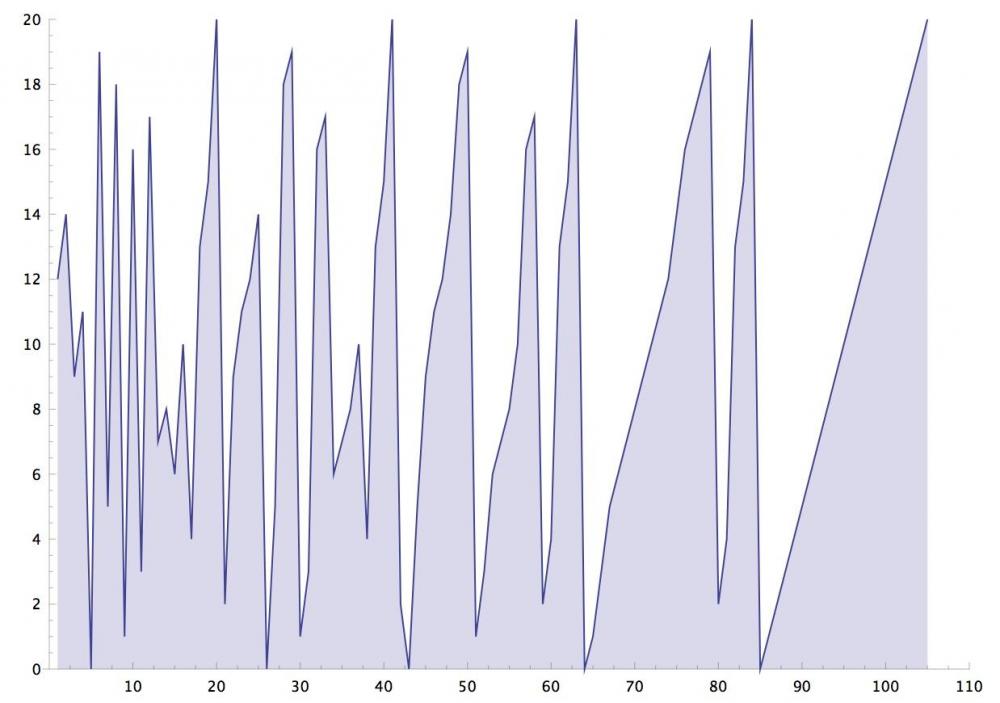
a kind of MERGE-SORT -> sorry for bad coding i didn't find a better solution -> perhaps a new SORT for GEN-SORT... (defun kind-of-merge-sort (alist) (progn (setf alist (mcflatten (loop repeat 30 do (setf alist (loop for i in (gen-divide 2 alist) collect (sort-asc (flatten i)))) collect alist))) (loop repeat (length alist) for cnt = 0 then (incf cnt) when (not (equal (nth cnt alist) (nth (1+ cnt) alist))) collect (nth cnt alist)))) (list-plot (flatten (kind-of-merge-sort (rnd-order (gen-integer 0 20)))) :join-points t :point-radius 0 :style :fill)
-
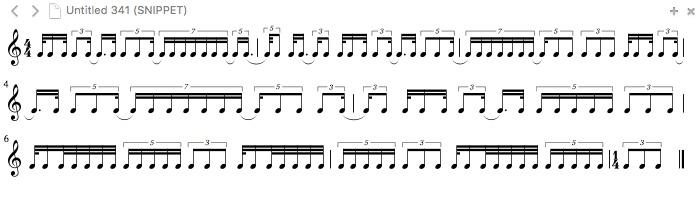
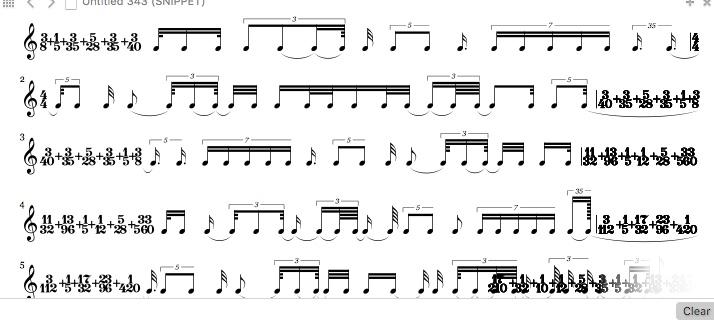
thanx stephane! ...but when you have a look on the output... (gen-retrograde durations1 :omn t) => ((t s t) (t 13/96 3q) (5h = 3/35 7q = = = = 3/35 5h =) (3q 13/96 t) (t s t)) or with FLATTEN: (gen-retrograde (flatten durations1) :omn t) => (t s t 3q 13/96 t 5h = 3/35 7q = = = = 3/35 5h = t 13/96 3q t s t) the "original notation" with no troubles => ((t s t) (3q 3e_s. t) (5h 5h 5q_7q 7q 7q 7q 7q 7q 7q_5q 5h 5h) (t s._3e 3q) (t s t))



-
for some score-display it would be very very useful if when EVAL etc... (or use any of the OPMO-functions) OMN-notation would be displayed and not changing to RATIOS... have a look to this example: it's written like that, because then the display is very smart. when i use "rnd-pick" or other functions it changes from OMN to RATIO... very ugly then. is there an internal solution for that or another trick? thanx for help a. ;; NICE DISPLAY BY CMD3 (setf durations1 (list '(t s t) '(3q 3e_s. t) '(5h 5h 5q_7q 7q 7q 7q 7q 7q 7q_5q 5h 5h) '(t s._3e 3q) '(t s t) )) => ((t s t) (3q 3e_s. t) (5h 5h 5q_7q 7q 7q 7q 7q 7q 7q_5q 5h 5h) (t s._3e 3q) (t s t)) ;;; UGLY DISPLAY BY CMD3 because of the OPMO-fuction (gen-retrograde durations1) ;; should result the same rhythm => ((1/32 1/16 1/32) (1/32 13/96 1/12) (1/10 1/10 3/35 1/28 1/28 1/28 1/28 1/28 3/35 1/10 1/10) (1/12 13/96 1/32) (1/32 1/16 1/32)) ;;; the same (rnd-pick durations1) => (1/32 13/96 1/12) ;;; OKAY because LISP and not OPMO (nth 0 durations1) => (t s t) a practical example: ;;; WORKS => because in the last step it's on LISP-level (setf durations (list '(t s t) '(3q 3e_s. t) '(5h 5h 5q_7q 7q 7q 7q 7q 7q 7q_5q 5h 5h) '(t s._3e 3q) '(t s t) '(t t t t) '(5q 5q 5q 5q 5q) '(3q 3q 3q) '(7q 7q 7q 7q 7q 7q 7q))) (setf morph-list (flatten (gen-morph 7 '(0 1 2 3) '(4 5 6 7)))) ;;cmd3 (setf newdurations (loop for i in morph-list append (nth i durations))) ;;; DON'T WORK => because OMPO chanhig the format to RATIOS (setf durations1 (list '(t s t) '(3q 3e_s. t) '(5h 5h 5q_7q 7q 7q 7q 7q 7q 7q_5q 5h 5h) '(t s._3e 3q) '(t s t))) (setf durations2 (list '(t t t t) '(5q 5q 5q 5q 5q) '(3q 3q 3q) '(7q 7q 7q 7q 7q 7q 7q))) ;;cmd3 (setf newdurations (flatten (gen-morph 7 durations1 durations2)))
-
with BAR and BEAT? that's great JANUSZ, you are always two steps ahead or "MILES AHEAD" (trumpeter's joke :-)) but WHEN will be the RELEASE?
-
thanx for the span-ignore-pause-HINT! ...but it makes no sense to me - when you are working with EVENTS (by numbering it) - to ignore some of them the idea behind this concept is, that you could work with a (finished) score by changing some parameters or enlarge rests - like a kind of "post-production". in this way it's not necessary to go deep inside you generating-algorithms, you can only change things a little bit like in a notation-software (i think it's on that level). some months ago i had the idea to do such changes (post...) by positions with BARS/BEATS - but at the moment i think it's much better to signify the EVENTS and work directly on them. less errors and easy to code such post...-functions.
-
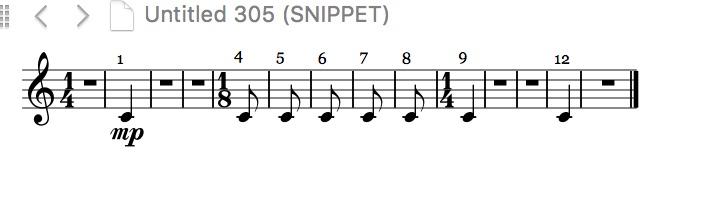
to use the function which works on event-numbers, first you have to number it (the score), so that you could work with this afterwards... ;;; ADD numbers to text attributes (can do that in your setup), then ADD number to events ;;; have a look to the example. after that, easy to use REPLACE-ON-EVENT-NUMBER etc... (defun add-numbers-to-text-attributes (a b) (loop for i from a to b append (add-text-attributes (list (compress (list 'nr i)) (write-to-string i))))) (add-numbers-to-text-attributes 0 100) (defun add-num-to-events (omnlist) (loop for x in (single-events omnlist) for i from 0 to (length (single-events omnlist)) when (omn-formp x) collect (omn-replace :articulation (list (compress (list 'nr i))) x) else collect x)) ;;; evaluate cmd3 (setf seq (add-num-to-events '(-q q c4 mp -q -q e e e e e q c4 mp -q -q q c4 mp -q))) => ((-q) (q c4 mp nr1) (-q) (-q) (e c4 mp nr4) (e c4 mp nr5) (e c4 mp nr6) (e c4 mp nr7) (e c4 mp nr8) (q c4 mp nr9) (-q) (-q) (q c4 mp nr12) (-q))
-
the same idea with INSERT/REPLACE (defun replace-on-event-number (omn-list &key position/list (type 'replace) (output nil)) (progn (setf omn-list (loop for i in (single-events omn-list) for cnt = 0 then (incf cnt) with position-list = (loop for x in position/list collect (car x)) with list = (loop for y in position/list collect (rest y)) with cnt2 = 0 when (= cnt (nth cnt2 position-list)) collect (cond ((equal type 'replace) (if (listp (nth cnt2 list)) (flatten (nth cnt2 list)) (nth cnt2 list))) ((equal type 'add) (list i (nth cnt2 list)))) else collect i when (and (= cnt (nth cnt2 position-list)) (< cnt (car (last position-list)))) do (incf cnt2))) (if (equal output 'flatten) (flatten omn-list) omn-list))) ;;; EXAMPLES REPLACE (replace-on-event-number '(q g4 -q q g4 g4 g4 -q g4 g4 g4 g4) :position/list '((1 (q g5d5)) (5 -q)) :type 'replace) => ((q g4 mf) (q g5d5) (q g4 mf) (q g4 mf) (q g4 mf) (-q) (q g4 mf) (q g4 mf) (q g4 mf) (q g4 mf)) (replace-on-event-number '(q g4 -q q g4 g4 g4 -q g4 g4 g4 g4) :position/list '((1 (q g5d5)) (5 -q)) :type 'replace :output 'flatten) => (q g4 mf q g5d5 q g4 mf q g4 mf q g4 mf -q q g4 mf q g4 mf q g4 mf q g4 mf) ;;; EXAMPLES ADD (replace-on-event-number '(q g4 -q q g4 g4 g4 -q g4 g4 g4 g4) :position/list '((1 -e.) (5 -w)) :type 'add :output nil) => ((q g4 mf) ((-q) (-e.)) (q g4 mf) (q g4 mf) (q g4 mf) ((-q) (-w)) (q g4 mf) (q g4 mf) (q g4 mf) (q g4 mf)) (replace-on-event-number '(q g4 -q q g4 g4 g4 -q g4 g4 g4 g4) :position/list '((1 (w g6 ffff)) (5 -w)) :type 'add :output 'flatten) => (q g4 mf -q w g6 ffff q g4 mf q g4 mf q g4 mf -q -w q g4 mf q g4 mf q g4 mf q g4 mf) ;;;;
-
it's not a common solution, only a specific for my project... 1) it should also work with chords - because it's made for EVENTS it's always one chord = one event 2) of course, you have to decide/check if you like to merge rests or not => because i'm filtering the texture by a binary-seq (binaries from a jpeg, like a sieve) it's not the idea to merge the rests, but you could do that in a seperate step. but in my case every note/event (before filtering) is numbered, so with/when BINARY-FILTER/SIEVE you will keep the numbering concise.
-
what you could do with it? a precise "projection on a curve" of a generated OMN (in this example: a 12-tone-row, which is been permuted (by a SORTING-algorithm) from start to end, till it's a symmetrical scale)
-
greetings andré ;;; --------------------------------------------------------------------------------------------------- ;;; because i'm working with numbered-events (to have some more control) i has to code ;;; a specific tranposition-function, which is transposing on specific spans/positions ;;; --------------------------------------------------------------------------------------------------- ;;; SUB (defun and-span (n a b) (and (>= n a) (<= n b))) ;;; MAIN (defun transpose-on-event-number (omn-list &key positions/transpose-list) (loop for i in (single-events omn-list) for cnt = 0 then (incf cnt) with position-list = (loop for x in positions/transpose-list collect (car x)) with transpose-list = (loop for y in positions/transpose-list collect (rest y)) with cnt2 = 0 when (and (and-span cnt (car (nth cnt2 position-list)) (cadr (nth cnt2 position-list))) (not (length-restp (car (omn :length i))))) collect (pitch-transpose-n (nth cnt2 transpose-list) i) else collect i when (and (= cnt (cadr (nth cnt2 position-list))) (< cnt (cadar (last position-list)))) do (incf cnt2))) ;;; ZERO-based (like in lisp) (transpose-on-event-number '(q g4 -q q g4 g4 g4 g4 g4 g4 g4 g4) :positions/transpose-list '(((0 5) 1) ((6 7) -3) ((8 9) 12))) => ((q gs4 mf) (-q) (q gs4 mf) (q gs4 mf) (q gs4 mf) (q gs4 mf) (q e4 mf) (q e4 mf) (q g5 mf) (q g5 mf))
-
i think it's good and important to see that opusmodus is not a notation software (like sibelius/finale/dorico...). the potential is rightly in another area and i believe that it is important to keep the basic idea of opusmodus in focus (it's important to have restrictions/limitations) - and i think the development team is very aware of that . you can not have everything, but what is possible should be very very smart in its kind. the longer i work with opusmodus, the more i realize, for what i can use it ...and when I have to switch to another platform. and because it is so open, it is then possible for me to find solutions for my specific needs, by being able to program myself and not simply having to do what the existing tools / functions allow. okay i admit i'm a big fan of opusmodus, although i do not even compose with it but can try/simulate basic ideas of my work - doing abstract/new things and see what happens - like working in an LAB
-
i coded a new/alternative version of LENGTH-INVERT. i used it for a so called BINARY-FILTER (for events) - have a look to the example and you see the reason. in some cases you will have a much better DISPLAY/SCORE, is there an OPMO version for that? greetings andré ;;; -------------------------------------------------------- ;;; VERSION WITH OPMO length-invert ;;; -------------------------------------------------------- (defun binary-filter-old (alist bin-list) (let ((event-list (cond ((omn-formp alist) (single-events alist)) (t alist)))) (flatten (loop for i in event-list for j in bin-list when (= j 1) collect i else append (list (length-invert (car i))))))) ;;; -------------------------------------------------------- ;;; VERSION WITH OWN length-invert ;;; -------------------------------------------------------- (defun binary-filter* (alist bin-list) (let ((event-list (cond ((omn-formp alist) (single-events alist)) (t alist)))) (flatten (loop for i in event-list for j in bin-list when (= j 1) collect i else append (list (length-invert** (car i))))))) (defun length-invert** (length-val) (append (compress (list '- length-val)))) EXAMPLE WITH THE ORIGINAL VERSION: ;;; EXAMPLE => complex rhythms (setf omn-seq (make-omn :length '(t s t 3q 3e_s. t 5h 5h 5q_7q 7q 7q 7q 7q 7q 7q_5q 5h 5h t s._3e 3q t s t) :pitch '(a4))) ;;; when you use my BINARY-FILTER_OLD which has the OPMO length-invert you will get a strange display-result (looks bad) ;; have a look with cmd3 (binary-filter-old omn-seq '(0 1 0 1 0 1 0 1 0 1 0 1 0 1 1 1 1 1 1 1)) => (-1/32 s a4 mf -1/32 3q a4 mf -13/96 t a4 mf -1/10 5h a4 mf -3/35 7q a4 mf -1/28 7q a4 mf -1/28 7q a4 mf 7q_5q a4 mf 5h a4 mf 5h a4 mf t a4 mf s._3e a4 mf 3q a4 mf) EXAMPLE WITH USING THE ALTERNATIVE VERSION: ;;; EXAMPLE => complex rhythms (setf omn-seq (make-omn :length '(t s t 3q 3e_s. t 5h 5h 5q_7q 7q 7q 7q 7q 7q 7q_5q 5h 5h t s._3e 3q t s t) :pitch '(a4))) ;;; when you use the new BINARY-FILTER with the new length-invert** ;; have a look with cmd3 (binary-filter* omn-seq '(0 1 0 1 0 1 0 1 0 1 0 1 0 1 1 1 1 1 1 1)) => (-t s a4 mf -t 3q a4 mf -3e_s. t a4 mf -5h 5h a4 mf -5q_7q 7q a4 mf -7q 7q a4 mf -7q 7q a4 mf 7q_5q a4 mf 5h a4 mf 5h a4 mf t a4 mf s._3e a4 mf 3q a4 mf) ;;; you see the FORMAT (-3e_s.) didn't changed in the rests (not -13/96), so it will be displayed well


-
;;; FUNCTION: for some coding-cases i needed THIS function, to keep the OMN-notation ;;; and not to change to RATIO (otherwise i got strange results in NOTATION because the "ties are gone") (defun length-invert** (length-val) (append (compress (list '- length-val)))) ;;; EXAMPLES ;;; new => keeps OMN (length-invert** (car '(q e4 mp))) => -q ; in this case i wanted to keep the format with tie (length-invert** (car '(3q_q e4 mp))) => -3q_q ;;; original => changes to ratio (length-invert (car '(q e4 mp))) => -1/4 ; no tie here! i was in trouble :-) (length-invert (car '(3q_q e4 mp))) => -1/3
-
i get an error... when i evaluate this (setf with-ch1 (omn-articulation-processor map (pitch-ornament (make-chord-if-length flow1 :interval-list '((-7 -19 3 9)(-4 -16 3 7) (-5 -17 4 12)(-3 -15 7)) :cycle nil :relative t :seed 729358 )))) > Error: OMN Parse Error: fail > While executing: omn-to-ast, in process Listener-2(13). > Type cmd-. to abort, cmd-\ for a list of available restarts. > Type :? for other options. ... problem seems to be: "omn-articulation-processor"
-
a release date für 1.3 ? greetings
-
okay... i think CT is also working on this problem?!
-
OVERWRITE FUNCTION: first time i'm working with this function (i coded it a year ago)... to overwrite the output/score => INSERTS.... - and it's very useful, perhaps JANUSZ could code an official OPMO-version of this which works perfect? greetings andré ;;; OVERWRITE!! ---------------------------------------------- (defun memberp (n liste) (not (equal 'nil (member n liste)))) (defun get-resolution2 (be) (cond ((memberp (cadr be) '(3 6 12 24 48)) 1/24) ((memberp (cadr be) '(1 2 4 8 16 32)) 1/16) ((memberp (cadr be) '(5 10 20 40)) 1/20) ((memberp (cadr be) '(7 14 28 56 1)) 1/28))) (defun overwrite (seq &key insert bar/beat) (car (last (let ((bar) (beat) (resolution) (distance)) (progn (setf bar (loop for i in bar/beat collect (car i)) beat (loop for j in bar/beat collect (cadr j))) (loop for ba in bar for be in beat for ins in insert with time-sign = (get-time-signature seq) with ord-time-sign = (get-time-signature seq) do (setf resolution (get-resolution2 be) time-sign (if (listp (car time-sign)) (loop for i in time-sign when (> (caddr i) 1) append (loop repeat (caddr i) collect (list (car i) (cadr i))) else collect (list (car i) (cadr i))) (append time-sign)) distance (if (listp (car time-sign)) (+ (sum (loop repeat (- ba 1) for i in time-sign collect (/ (/ (car i) (cadr i)) (get-resolution2 be)))) (/ (/ (1- (car be)) (cadr be)) (get-resolution2 be))) (+ (/ (* (1- ba) (/ (car time-sign) (cadr time-sign))) (get-resolution2 be)) (/ (/ (1- (car be)) (cadr be)) (get-resolution2 be))))) do (setf seq (omn-to-time-signature (length-rest-merge (omn-merge-ties (flatten (loop repeat (length (omn-to-time-signature seq (list (numerator resolution) (denominator resolution)))) for cnt = 0 then (incf cnt) with new-seq = (omn-to-time-signature seq (list (numerator resolution) (denominator resolution))) with ins-rounded = (append ins (rest (length-rational-quantize (list (apply '+ (omn :length ins))) :round resolution))) when (= cnt distance) collect ins-rounded and do (setf cnt (+ (/ (get-span (flatten ins-rounded)) resolution) cnt -1)) else collect (nth cnt new-seq))))) ord-time-sign)) do (setf time-sign ord-time-sign) collect seq)))))) TWO EXAMPLES: ;;; in a 3/4 (setf seq1 '((e c6 a5 h b5 tie) (q b5 b5 a5 tie) (h a5 q a5) (h. g5))) (overwrite seq1 :insert '((3q c5 b4 bb4 a4) (3q c4 b3 bb3 a3)) :bar/beat '((2 (2 12)) (3 (7 12)))) ;;; with changing time-signatures (setf seq2 '((e c6 a5 h b5 q tie) (q b5 b5 a5 tie) (q a5 q a5) (h. g5))) (overwrite seq2 :insert '((3q c5 b4 bb4 a4) (3q c4 b3 bb3 a3)) :bar/beat '((1 (2 12)) (3 (1 12))))
-
short information about this from CT: "Currently, only the VST plugin does the pitch bend correctly, there was some reason why I did not fix the problem with the Max version, but I'll take it now. In the short term, you can also solve it by sending the pitchbend value immediately after each noteon. Pitchbend + - tritone." https://www.contimbre.com/en/ but how to how to send "the pitchbend value immediately after each noteon. Pitchbend + - tritone." ...i have no idea, i will wait for the UPDATE