
Posts posted by JulioHerrlein
-
-
-

Hi, all
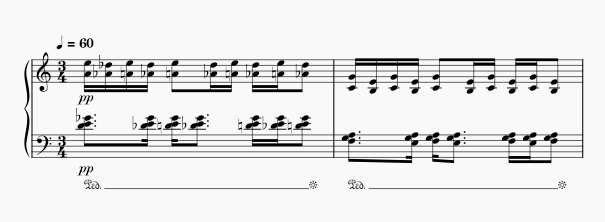
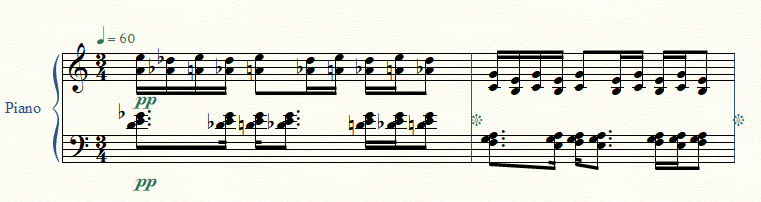
THis snippet apears as sextuplets in the notation viewer but opens as triplets in Musescore, after open in external editor
((6q gs3 cs4 eb4 b3 cs4 gs3 cs4 b3 gs4 e4 b3 cs4)
(6q f3 bb3 cs4 g3 bb3 f3 bb3 gs3 f4 b3 bb3 f3)
(6q eb4 e3 bb3 eb4 fs4 b3 f4 fs3 g3 f4 gs4 e4))
something strange...
Im in the version 4.0.31480
-
-
-
-
-
Thank you !!
Below is a much better version. In the new version, the function rounds the notes selectively, according to the spelling and there is no need to rewrite-acidentals. If the referential collection have more sharps the function rounds up and vice-versa for the flats. Also, it preserve the spelling of the referential collections (i.e. tonalities).
Best !
Julio
(defun set-transpose (n omn-sequence sets &key (round 'up))"Transposição diatônica paramétrica com arredondamento seletivo:'up' para sets com mais sustenidos e 'down' para sets com mais bemóis."(let* ((dis (disassemble-omn omn-sequence))(pitches (getf dis :pitch))(num-bars (length pitches))(n-list (gen-trim num-bars (if (listp n) n (list n))))(set-list (gen-trim num-bars sets)))(labels ((process-pitch (p val-n collection local-round)(let* ((p-int (pitch-to-integer p))(coll-ints (pitch-to-integer (flatten collection)))(coll-pcs (sort (remove-duplicates(mapcar (lambda (x) (mod x 12)) coll-ints))#'<))(len-coll (length coll-pcs)))(flet ((transpose-single (single-p)(let* ((pc (mod single-p 12))(oct (floor single-p 12));; 1. Arredondamento seletivo detectado para este bar(r-info (get-rounded-info pc coll-pcs local-round))(rounded-pc (car r-info))(r-oct-shift (cdr r-info));; 2. Transposição diatônica por índices(curr-idx (position rounded-pc coll-pcs))(new-idx (+ curr-idx val-n));; 3. Ajuste de oitava final (modular)(final-oct-shift (+ r-oct-shift (floor new-idx len-coll)))(final-pc (nth (mod new-idx len-coll) coll-pcs)))(+ (* (+ oct final-oct-shift) 12) final-pc))))(if (listp p-int)(mapcar #'transpose-single p-int)(transpose-single p-int)))))(get-rounded-info (pc coll direction)(if (member pc coll)(cons pc 0)(case direction(up (let ((higher (find pc coll :test #'<)))(if higher (cons higher 0) (cons (first coll) 1))))(down (let ((lower (find pc coll :from-end t :test #'>)))(if lower (cons lower 0) (cons (car (last coll)) -1)))))))(spell-note (int-val bar-set)"Reconstrói o símbolo OMN com oitava correta (c4=0) e spelling do set."(let* ((pc (mod int-val 12))(oct-suffix (+ 4 (floor int-val 12)))(ref-note (find pc (flatten (pitch-to-integer bar-set)):test (lambda (x y) (= x (mod y 12))))))(if ref-note(let* ((all-notes (flatten bar-set))(orig-sym (nth (position ref-note (pitch-to-integer all-notes)) all-notes))(pure-name (string-right-trim "0123456789" (symbol-name orig-sym))))(intern (format nil "~a~d" pure-name oct-suffix)))(car (integer-to-pitch (list int-val)))))));; --- PROCESSAMENTO BAR-A-BAR COM ARREDONDAMENTO SELETIVO ---(let ((final-pitches(mapcar (lambda (bar bar-n bar-set)(let* ((set-syms (flatten (list! bar-set)));; A. Conta sustenidos (s) e bemóis (b) no set(sharps (count-if (lambda (s) (search "s" (symbol-name s) :test #'char-equal)) set-syms))(flats (count-if (lambda (s) (search "b" (symbol-name s) :test #'char-equal)) set-syms));; B. Define a direção de arredondamento local(local-round (cond ((> sharps flats) 'up)((> flats sharps) 'down)(t round))) ;; Mantém o default se empatar;; C. Processa as notas com o arredondamento calculado(trans-ints (mapcar (lambda (p) (process-pitch p bar-n bar-set local-round)) bar)))(mapcar (lambda (item)(if (listp item)(intern (format nil "~{~a~}" (mapcar (lambda (sub) (spell-note sub bar-set)) item)))(spell-note item bar-set)))trans-ints)))pitches n-list set-list)))(make-omn :pitch final-pitches:length (getf dis :length):velocity (getf dis :velocity):articulation (getf dis :articulation))))))EXAMPLE
(setf temav1 (gen-repeat 3 '((e. c4 mf s d4 -e e4 e. f4 s g4 - a4) (q b4 mf -e c4 e. d4 s e4 - f4) (q g4 mf -e a4 e. b4 s c4 - d4))))(setf sets (expand-tonality '((e4 major) (ab4 major) (c4 major) (c4 diminished1))))
(set-transpose 0 temav1 sets)
((e. cs4 mf s ds4 -e e4 e. fs4 s gs4 - a4) (q bb4 mf -e c4 e. db4 s eb4 - f4) (q g4 mf -e a4 e. b4 s c4 - d4) (e. c4 mf s ds4 -e e4 e. fs4 s g4 - a4) (q b4 mf -e cs4 e. ds4 s e4 - fs4) (q g4 mf -e ab4 e. bb4 s c4 - db4) (e. c4 mf s d4 -e e4 e. f4 s g4 - a4) (q c5 mf -e c4 e. ds4 s e4 - fs4) (q gs4 mf -e a4 e. b4 s cs4 - ds4))
(set-transpose -3 temav1 sets)
((e. gs3 mf s a3 -e b3 e. cs4 s ds4 - e4) (q f4 mf -e g3 e. ab3 s bb3 - c4) (q d4 mf -e e4 e. f4 s g3 - a3) (e. g3 mf s as3 -e c4 e. cs4 s ds4 - e4) (q fs4 mf -e gs3 e. a3 s b3 - cs4) (q db4 mf -e eb4 e. f4 s g3 - ab3) (e. g3 mf s a3 -e b3 e. c4 s d4 - e4) (q g4 mf -e g3 e. as3 s c4 - cs4) (q ds4 mf -e e4 e. fs4 s gs3 - a3))
-
Dear All,
Here are a version for a diatonic (or all purpose set-transpose) function that rounds material around a collection used as reference).
Please, Let me know if you find bugs.
Best,
Julio
(defun set-transpose (n omn-sequence sets &key (round 'up))"Realiza transposição diatônica por N passos em coleções de referência.Arredonda notas fora do set para cima ou para baixo conforme :round."(let* ((dis (disassemble-omn omn-sequence))(pitches (getf dis :pitch))(num-bars (length pitches));; Alinha N e os Sets ao número de sublistas (compassos)(n-list (gen-trim num-bars (if (listp n) n (list n))))(set-list (gen-trim num-bars sets)))(labels ((process-pitch (p val-n collection)(let* ((p-int (pitch-to-integer p));; Normaliza a coleção para pitch-classes (0-11) ordenadas(coll-pcs (sort (remove-duplicates(mapcar (lambda (x) (mod x 12))(flatten (pitch-to-integer collection))))#'<))(len-coll (length coll-pcs)))(flet ((transpose-single (single-p)(let* ((pc (mod single-p 12))(oct (floor single-p 12));; 1. Arredondamento com info de oitava(r-info (get-rounded-info pc coll-pcs round))(rounded-pc (car r-info))(r-oct-shift (cdr r-info));; 2. Localiza índice e aplica N passos diatônicos(curr-idx (position rounded-pc coll-pcs))(new-idx (+ curr-idx val-n));; 3. Calcula deslocamento de oitava final (wrap-around)(final-oct-shift (+ r-oct-shift (floor new-idx len-coll)))(final-pc (nth (mod new-idx len-coll) coll-pcs)));; 4. Reconstrói o pitch mantendo o registro original(+ (* (+ oct final-oct-shift) 12) final-pc))));; Suporte para notas individuais ou acordes(if (listp p-int)(mapcar #'transpose-single p-int)(transpose-single p-int)))))(get-rounded-info (pc coll direction);; Retorna (rounded-pc . octave-shift)(if (member pc coll)(cons pc 0)(case direction(up (let ((higher (find pc coll :test #'<)))(if higher(cons higher 0)(cons (first coll) 1)))) ;; Wrap up: vai p/ próx oitava(down (let ((lower (find pc coll :from-end t :test #'>)))(if lower(cons lower 0)(cons (car (last coll)) -1)))))))) ;; Wrap down: oitava anterior;; Mapeamento bar-a-bar(let ((new-pitches (mapcar (lambda (bar bar-n bar-set)(mapcar (lambda (p) (process-pitch p bar-n bar-set)) bar))pitches n-list set-list)));; Remontagem OMN final preservando os outros parâmetros(make-omn :pitch (integer-to-pitch new-pitches):length (getf dis :length):velocity (getf dis :velocity):articulation (getf dis :articulation))))))EXAMPLE
(setf temav1 '((e. a4 mf s -e c5 e. f4 s g4 - a4) (q c5 mf -e bb4 e. eb5 s ab4 - eb5) (q cs5 mf -e e5 e. as4 s b4 - cs5)))
(setf sets (expand-tonality '((ab4 major) (c4 major))))
(set-transpose -4 temav1 sets :round 'down)
((e. cs4 mf s -e f4 e. bb3 s c4 - cs4) (q f4 mf -e d4 e. g4 s c4 - g4) (q g4 mf -e gs4 e. eb4 s - g4))
(set-transpose -4 temav1 sets :round 'up)
((e. eb4 mf s -e f4 e. bb3 s c4 - eb4) (q f4 mf -e e4 e. a4 s d4 - a4) (q g4 mf -e bb4 e. eb4 s f4 - g4))
(setf sets (expand-tonality '((ab4 messiaen-mode2) (c4 major))))
(set-transpose -4 temav1 sets :round 'up)
-
Dear All,
An useful function do make various pitch-demix operations at once.
(defun poly-demix (n-list mat-omn)"Extrai as vozes especificadas em N-LIST de uma sequência OMNe as combina em um único fluxo polifônico."(let* (;; 1. Garante que n-list seja uma lista e extrai cada voz(extracted-voices (mapcar #'(lambda (n)(pitch-demix n mat-omn))(list! n-list))));; 2. Aplica merge-voices sobre a lista de vozes extraídas(apply #'merge-voices extracted-voices)))(setf mat-omn '((e. g2bb3d4f4a4 mf s -e e c4c5c5 e. g2bb3c4d4f4 s g3g4g4 -s s g2bb3d4f4a4) (q bb2db4f4ab4c5 mf -e e bb3bb4bb4 e. eb4eb5eb5 s ab3ab4ab4 -s s bb2db4ab4c5eb5)))
(poly-demix '(1 2 5) mat-omn)
((e. g2f4a4 s -e c5 e. g2d4f4 s g4 - g2f4a4) (q bb2ab4c5 -e bb4 e. eb5 s ab4 - bb2c5eb5))
Best, Julio
-
-
Dear Windows Users,
After the Windows 11 26200.7840 Security Update (February 11th 2026), the virtual ports are not showing in windows, only the hardware ones.
At first I though it was related to Opusmodus update, but it´s a windows update BUG.Here is the solution.
Close all MIDI apps
Open Windows Terminal as an Administrator (“run as administrator”)
Type "net stop midisrv"
After that completes, type "net start midisrv"
Start up the app you want to use with MIDI
Here is a video:
Best, Julio
-
-
Ciao, Opusmoders
All previous rewrite functions used in conjunction for transformations.
Ciao !
https://opusmodus.com/forums/topic/4097-rewrite-len-function/#comment-14209
(setf expressao-omn '((s eb4 d4 e a4 -s s eb4) (h eb4 a4 -s eb4 d4 -s)(e. d4 a4 eb4 d4)(-q e f4 s c5 qs fs4)))
(rewrite-pit(rewrite-dyn(rewrite-len expressao-omn'(h -e s q -h q -q s s s))'(pp< ff mf fff p < < fff ppp fff mf fff p))'(c4 g5))
https://opusmodus.com/forums/topic/4097-rewrite-len-function/#comment-14209
-
Last one... Time to go to bed in Brasil
Function to rewrite lengths
BEst,
Julio
(defun rewrite-len (expressao-omn new-lengths-list)"Substitui os comprimentos (lengths) de uma expressão OMN por uma lista fornecida,repetindo-a ciclicamente e mantendo a estrutura de sublistas original."(let* ((dis (disassemble-omn expressao-omn)) ;; Desmonta a expressão original [2](old-pit (getf dis :pitch)) ;; Extrai as alturas [4](old-vel (getf dis :velocity)) ;; Extrai as velocidades [4](old-art (getf dis :articulation)) ;; Extrai as articulações [4];; 1. Mapeia a estrutura original (quantidade de eventos por sublista);; Captura o número de elementos rítmicos em cada compasso [3, 5](structure (mapcar #'length (getf dis :length)))(total-events (apply #'+ structure)) ;; Soma total de eventos [6];; 2. Gera a sequência rítmica cíclica com base no total de eventos;; gen-trim estende a lista do usuário para preencher todos os espaços [3, 7](new-flat-lengths (gen-trim total-events new-lengths-list));; 3. Re-organiza os novos ritmos na estrutura de sublistas original [3, 8](new-structured-lengths (gen-divide structure new-flat-lengths)));; 4. Remonta o objeto OMN completo com os parâmetros preservados [3, 4](make-omn :pitch old-pit:length new-structured-lengths:velocity old-vel:articulation old-art)));;USE
(setf expressao-omn '((s eb4 d4 e a4 -s s eb4) (h eb4 a4 -s eb4 d4 -s)(e. d4 a4 eb4 d4)(-q e f4 s c5 qs fs4)))(omn-to-time-signature (rewrite-len expressao-omn '(h -e s q -h q -q s s s)) '(3 4));;RESULT
((h eb4 mf -e s d4 a4 tie) (e. a4 -h s eb4 mf tie) (e. eb4 mf -q s a4 eb4 d4 e eb4 tie) (q. eb4 -e s d4 mf e. a4 tie) (s a4 -h e. f4 mf tie) (s f4 mf -q s c5 fs4)) -
Hey, Opusmoders
Here is one more function in the style of the previous one (rewrite-dyn). This time to rewrite pitches.
(defun rewrite-pit (expressao-omn pitch-list)"Substitui as alturas de uma expressão OMN por uma lista customizada,fazendo a repetição cíclica se a lista for menor que o número de notas."(let* ((dis (disassemble-omn expressao-omn)) ;; Desmonta a expressão [3, 6](pitches (getf dis :pitch)) ;; Extrai alturas atuais(lengths (getf dis :length)) ;; Extrai durações (inclui rests) [7](velocities (getf dis :velocity)) ;; Extrai dinâmicas [8](articulations (getf dis :articulation)) ;; Extrai articulações/ties [9, 10];; 1. Mapeia a quantidade de notas em cada sublista/compasso(counts (mapcar #'length pitches)) ;; [2, 5];; 2. Calcula o total de eventos de nota para o preenchimento(total-notes (apply #'+ (flatten counts))) ;; [2, 11];; 3. Gera a lista de novas alturas repetindo o padrão do usuário(flat-pitches (gen-trim total-notes pitch-list)) ;; [2, 4];; 4. Redistribui as alturas na estrutura de sublistas original(structured-pitches (gen-divide counts flat-pitches))) ;; [2, 5];; 5. Remonta o objeto OMN completo preservando os demais parâmetros(make-omn :pitch structured-pitches:length lengths:velocity velocities:articulation articulations))) ;; [2, 3];;USE
(setf expressao-omn '((s eb4 d4 e a4 -s s eb4 tie) (h eb4 a4 -s eb4 d4 -s tie)(e. d4 a4 eb4 d4)(-q e f4 s c5 qs fs4)))Using both rewrite-dyn and rewrite-pit
(rewrite-pit expressao-omn '(c4 e4 d4 c4 c4))(rewrite-dyn (rewrite-pit expressao-omn '(c4 e4 d4 c4 c4)) '(ff > p p< ff> pp ff p p< ff p mf ppp p < ff))Best !!
Julio Herrlein
-
Hello, Opusmoders
This is a very cool and easy to use function to rewrite dynamics.
Check it out. Hope you like it !
Best,
Julio
(defun rewrite-dyn (expressao-omn dynamic-list)"Substitui as dinâmicas de uma expressão OMN por uma lista customizada,fazendo a rotação cíclica se a lista for menor que o número de notas."(let* ((dis (disassemble-omn expressao-omn)) ; [2, 3](pitches (getf dis :pitch))(lengths (getf dis :length))(articulations (getf dis :articulation));; 1. Mapeia a estrutura de cada sublista (quantidade de notas por compasso)(counts (mapcar #'length pitches)) ; [6];; 2. Calcula o total de notas para gerar dinâmicas suficientes(total-notes (apply #'+ (flatten counts))) ; [7];; 3. Cria a lista plana de dinâmicas repetindo o padrão do usuário [4](flat-vels (gen-trim total-notes dynamic-list));; 4. Redistribui as dinâmicas na estrutura de sublistas original [5](structured-vels (gen-divide counts flat-vels)));; 5. Remonta o objeto OMN completo com os novos parâmetros [3](make-omn :pitch pitches:length lengths:velocity structured-vels:articulation articulations)));; USE
;; Exemplo 1: Dinâmicas simples
(setf expressao-omn '((s eb4 d4 e a4 -s s eb4 tie) (h eb4 a4 -s eb4 d4 -s tie)(e. d4 a4 eb4 d4)(-q e f4 s c5 qs fs4)))
(rewrite-dyn expressao-omn '(p mf ff));; >> ((s eb4 p d4 mf e a4 ff -s eb4 p tie) (h eb4 mf a4 ff -s eb4 p d4 mf - d4 ff tie) (e. d4 p a4 mf eb4 ff d4 p) (-q e f4 mf s c5 ff qs fs4 p));; Exemplo 2: Incluindo crescendos
(rewrite-dyn expressao-omn '(ff > p p< ff> pp ff p p< ff p mf ppp p < ff));; ((s eb4 ff d4 > e a4 p -s eb4 p< tie) (h eb4 ff> a4 pp -s eb4 ff d4 p - d4 p< tie) (e. d4 ff a4 p eb4 mf d4 ppp) (-q e f4 p s c5 < qs fs4 ff))
-
Hello, Opusmoders
Sometime ago I was here searching for a function to displace rhtyhms by a length amount, not just like a list rotation.
Now I did this prototype. I think that this can be very useful, specially inside counterpoint dictums where patterns can be displaced ( I did not tried inside the counterpoint function but seems like it will work).
Hope it can be useful to you too.
All the best,
Julio
(defun shift-rhythm (rhythm shift-length &key span);"Moves rhythmic material by inserting a pause at the beginning.;Use length-adjust to ensure the result fits within the span."(let* ((rhy (flatten rhythm));;;; Ensures a linear list for processing;; Adds the offset value as a negative pause at the beginning [5](with-offset (append (list (- (abs shift-length))) rhy));;Define the target span: either the requested one or the original rhythm.(target-span (or span (get-span rhythm))));; The length-adjust function adjusts the total to the desired span [1].;; With :position 'e (default), it removes or adds from the end of the list [6].(length-adjust target-span with-offset :omn t :type 'r)));;; USE;Exemplo 1: Span de 4/4 (1/1)(setf ideia '(e c5 e d4 q f4 -h)) ;; Span original de 1/1(shift-rhythm ideia 1/8 :span 3/4);; (-e e c5 d4 q f4 -e)(shift-rhythm ideia 3/8 :span 5/4);; (-q. e c5 d4 q f4 -q.)also with negative displacement
(setf ideia '(-h e c5 e d4 q f4 -h))(shift-rhythm ideia -1/8 :span 7/4);;(-e -h e c5 d4 q f4 -h -e)It could be perfected to deal with nested sublists and with different displacements for each sublist, like
(setf ideia '((-h e c5 e d4 q f4 -h)(-h e c5 e d4 q f4 -h.)(-h e c5 e d4 q f4 -q))
(shift-rhythm ideia '((-1/8) (2/16) (3/8)) :span 7/4)
etc
-
-
I did all this and get this on the listener
I tried in the first time just deleting the filies you mentioned and got the same error
the second time I deleted the content of bin and libclm folders the opusmodus installer built/compiled the files again before restarting.
I got this in the listener:
OM 1 >
; Loading text file E:\Opusmodus\clm\CLM Startup Instruments.lisp
load-clm-ins, instruments: ("add-noise-filtered" "add" "addflt" "addsnd" "anoi" "arith" "arith1" "arith2" "autoc" "backandforth" "badd" "bandedwg" "bell" "bigbird" "bird" "bowl" "btest" "canter" "cellon" "circular-scanned" "cnv" "convolve" "cross-synthesis" "drone" "expandn" "expsrc" "fade" "fft" "filter-noise" "fltnoi" "fltsnd" "flute" "fm-bass" "fmex" "fmtest" "freeverb" "fullmix" "get-spectrum" "gen-control" "gen-delays" "gen-feedback" "gen-file-processing" "gen-filters" "gen-followers" "gen-formants" "gen-mixed-demo" "gen-modulation" "gen-noise" "gen-oscillators" "gen-random-modulation" "gen-reverb" "gen-spatial" "gen-spectral" "gen-utilities" "grani" "granular" "grapheq" "insect" "jcrev" "jcrevf" "jcvoi" "jlrev" "kiprev" "lbjPiano" "leslie" "maraca" "maxf" "mlbvoi" "move-sound" "noise" "nrev" "one-cut" "piano" "pluck" "pm-pulse" "pqw" "pqwvox" "prc95" "prc96" "pvoc" "resflt" "reson" "rev2" "ring-modulate" "rmsenv" "san" "scanned" "scentroid" "shepard" "singer" "sndwarp" "stochastic" "strad" "tb" "tnot" "track-rms" "trp" "ug" "ug1" "ug2" "ug3" "ug4" "ugex" "v" "vowel" "vox" "vslf" "vsum" "waveguide-flute" "wavetrain" "zd" "zipper")
; Loading fasl file E:\Opusmodus\clm\bin\add-noise-filtered.64ofasl
; Loading fasl file E:\Opusmodus\clm\bin\add.64ofasl
; Loading fasl file E:\Opusmodus\clm\bin\addflt.64ofasl
; Loading fasl file E:\Opusmodus\clm\bin\addsnd.64ofasl
; Loading fasl file E:\Opusmodus\clm\bin\anoi.64ofasl
; Loading fasl file E:\Opusmodus\clm\bin\arith.64ofasl
; Loading fasl file E:\Opusmodus\clm\bin\arith1.64ofasl
; Loading fasl file E:\Opusmodus\clm\bin\arith2.64ofasl
; Loading fasl file E:\Opusmodus\clm\bin\autoc.64ofasl
; Loading fasl file E:\Opusmodus\clm\bin\backandforth.64ofasl
; Loading fasl file E:\Opusmodus\clm\bin\badd.64ofasl
; Loading fasl file E:\Opusmodus\clm\bin\bandedwg.64ofasl
; Loading fasl file E:\Opusmodus\clm\bin\bell.64ofasl
; Loading fasl file E:\Opusmodus\clm\bin\bigbird.64ofasl
; Loading fasl file E:\Opusmodus\clm\bin\bird.64ofasl
; Loading fasl file E:\Opusmodus\clm\bin\bowl.64ofasl
; Loading fasl file E:\Opusmodus\clm\bin\btest.64ofasl
; Loading fasl file E:\Opusmodus\clm\bin\canter.64ofasl
; Loading fasl file E:\Opusmodus\clm\bin\cellon.64ofasl
; Loading fasl file E:\Opusmodus\clm\bin\circular-scanned.64ofasl
; Loading fasl file E:\Opusmodus\clm\bin\cnv.64ofasl
; Loading fasl file E:\Opusmodus\clm\bin\convolve.64ofasl
; Loading fasl file E:\Opusmodus\clm\bin\cross-synthesis.64ofasl
; Loading fasl file E:\Opusmodus\clm\bin\drone.64ofasl
; Loading fasl file E:\Opusmodus\clm\bin\expandn.64ofasl
; Loading fasl file E:\Opusmodus\clm\bin\expsrc.64ofasl
;;; Compiling file E:\Opusmodus\clm\instruments\fade.ins ...
;;; Safety = 3, Speed = 1, Space = 1, Float = 1, Interruptible = 1
;;; Compilation speed = 1, Debug = 2, Fixnum safety = 3
;;; Source level debugging is off
;;; Source file recording is on
;;; Cross referencing is off
; (lispworks:top-level-form 0)
; (lispworks:top-level-form 1)
; Writing "E:\\Opusmodus\\clm\\libclm\\clm_cross_fade.c"
; (lispworks:top-level-form 2)
; Compiling "E:\\Opusmodus\\clm\\libclm\\clm_cross_fade.c"
; Created shared object file "E:\\Opusmodus\\clm\\libclm\\clm_cross_fade.dll"
; (lispworks:top-level-form 2)
; (harlequin-common-lisp:subfunction |clm_cross_fade3| (fli:define-foreign-function |clm_cross_fade3|))
; (fli:define-foreign-function |clm_cross_fade3|)
; (lispworks:top-level-form 2)
; cross-fade
; cross-fade2
; (lispworks:top-level-form 2)
; Writing "E:\\Opusmodus\\clm\\libclm\\clm_dissolve_fade.c"
; (lispworks:top-level-form 3)
; Compiling "E:\\Opusmodus\\clm\\libclm\\clm_dissolve_fade.c"
; Created shared object file "E:\\Opusmodus\\clm\\libclm\\clm_dissolve_fade.dll"
; (lispworks:top-level-form 3)
; (harlequin-common-lisp:subfunction |clm_dissolve_fade5| (fli:define-foreign-function |clm_dissolve_fade5|))
; (fli:define-foreign-function |clm_dissolve_fade5|)
; (lispworks:top-level-form 3)
; dissolve-fade
; dissolve-fade4
; (lispworks:top-level-form 3)
Error: Failed to rename file E:\Opusmodus\clm\bin\t_fade.64ofasl: The process cannot access the file because it is being used by another process(32).
1 (continue) Try to rename #P"E:/Opusmodus/clm/bin/t_fade.64ofasl" to #P"E:/Opusmodus/clm/bin/fade.64ofasl" again.
2 Try compiling E:\Opusmodus\clm\instruments\fade.ins again.
3 Skip compiling E:\Opusmodus\clm\instruments\fade.ins.
4 (abort) Return to top loop level 0.
Type :b for backtrace or :c <option number> to proceed.
Type :bug-form "<subject>" for a bug report template or :? for other options.
OM 2 : 1 >
And this error message window (similar to the other i got before)
While loading file E:\Opusmodus\User Source\Extensions\Load CLM Instruments.lisp
Failed to compile C file "(E:\Opusmodus\clm\libclm\clm_cross_fade.c
E:\Opusmodus\clm\libclm\libclm-o64.lib)" with error 2.
>>>>>>>Output:
C:\Users\Desk2025\AppData\Local\Temp\lwtemp_DESKTOP-MIMK850_1514818fyrXD.bat
E:\Opusmodus\CLM\instruments>call "c:\Program Files\Microsoft Visual
Studio\18\Community\VC\Auxiliary\Build\vcvars64.bat"
**********************************************************************
** Visual Studio 2026 Developer Command Prompt v18.4.3
** Copyright (c) 2026 Microsoft Corporation
**********************************************************************
[vcvarsall.bat] Environment initialized for: 'x64'
Microsoft (R) C/C++ Optimizing Compiler Version 19.50.35728 for x64
Copyright (C) Microsoft Corporation. All rights reserved.
clm_cross_fade.c
Microsoft (R) Incremental Linker Version 14.50.35728.0
Copyright (C) Microsoft Corporation. All rights reserved.
/dll
/implib:E:\Opusmodus\clm\libclm\clm_cross_fade.lib
/out:E:\Opusmodus\clm\libclm\clm_cross_fade.dll
/export:clm_cross_fade1
E:\Opusmodus\clm\libclm\clm_cross_fade.obj
E:\Opusmodus\clm\libclm\libclm-o64.lib
LINK : error LNK2001: unresolved external symbol clm_cross_fade1
E:\Opusmodus\clm\libclm\clm_cross_fade.lib : fatal error LNK1120: 1 unresolved externals
-
Still trying with the latest version.
Now my message reads like this:
While loading file E:\Opusmodus\User Source\Extensions\Load CLM Instruments.lisp
Failed to compile C file "(E:\Opusmodus\clm\libclm\clm_cross_fade.c
E:\Opusmodus\clm\libclm\libclm-o64.lib)" with error 2.
>>>>>>>Output:
C:\Users\Desk2025\AppData\Local\Temp\lwtemp_DESKTOP-MIMK850_528834jfFWfB.bat
E:\Opusmodus\CLM\instruments>call "c:\Program Files\Microsoft Visual
Studio\18\Community\VC\Auxiliary\Build\vcvars64.bat"
**********************************************************************
** Visual Studio 2026 Developer Command Prompt v18.4.3
** Copyright (c) 2026 Microsoft Corporation
**********************************************************************
[vcvarsall.bat] Environment initialized for: 'x64'
Microsoft (R) C/C++ Optimizing Compiler Version 19.50.35728 for x64
Copyright (C) Microsoft Corporation. All rights reserved.
clm_cross_fade.c
Microsoft (R) Incremental Linker Version 14.50.35728.0
Copyright (C) Microsoft Corporation. All rights reserved.
/dll
/implib:E:\Opusmodus\clm\libclm\clm_cross_fade.lib
/out:E:\Opusmodus\clm\libclm\clm_cross_fade.dll
/export:clm_cross_fade103
E:\Opusmodus\clm\libclm\clm_cross_fade.obj
E:\Opusmodus\clm\libclm\libclm-o64.lib
LINK : error LNK2001: unresolved external symbol clm_cross_fade103
E:\Opusmodus\clm\libclm\clm_cross_fade.lib : fatal error LNK1120: 1 unresolved externals
-
Dear Janusz,
Have you tried in a windows machine ?
I installed the Full version of Visual Studio and reinstalled Opusmodus in the usual C: directory. It solved the startup error mentioned above, but...
My workspace is in a different hard disk, to avoid loose my files in case of crashing the OS (but is in a top directory, withoud subfolders) like
E:\Opusmodus
The CLM new content was copied and also the Lisp file

Getting this...
(with-sound (:channels 2)
(badd 0 1.5 220 .2
:partials '(1 1 .5 .3 2 .2 3 .1)
:ampfun '(0 0 1 1 2 0)
:degree 40
:reverb .1))
OM 8 > with-sound
Error: Undefined operator badd in form (badd 0 1.5 220 0.2 :partials (quote (1 1 0.5 0.3 2 0.2 3 0.1)) :ampfun (quote (0 0 1 1 2 0)) :degree 40 :reverb 0.1).
Best ! Julio
-
Thanks a lot, Janusz
This is an important update.
Please, if possible, can you provide the exact links to this complementations ?
Because there are many versions and updates in windows...
Yes, important to add in the Readme files, specially for WIN users.
Looking forward to use this. So cool !
BEst,
Julio
-
I reinstalled Opusmodus, copied the new CLM folder to home directory and now I get this at the startup
While loading file E:\Opusmodus\User Source\Extensions\Load CLM Instruments.lisp
trying to compile C file ("E:\\Opusmodus\\clm\\libclm\\clm_add_noise_filtered.c"
"E:\\Opusmodus\\clm\\libclm\\libclm-o64.lib"): didn't find a compiler
Please, someone can help ? (WINDOWS)
-
Thanks, Janusz
But all the other stuff works well. I´m using this structure of files for years... I´ll try to figure out.
Best,
Still geting this... I´ll try later. I do not use this very much, but I´d like to explore more.
(with-sound (:channels 2)
(badd 0 1.5 220 .2
:partials '(1 1 .5 .3 2 .2 3 .1)
:ampfun '(0 0 1 1 2 0)
:degree 40
:reverb .1))
OM 1 > with-sound
Error: Undefined operator badd in form (badd 0 1.5 220 0.2 :partials (quote (1 1 0.5 0.3 2 0.2 3 0.1)) :ampfun (quote (0 0 1 1 2 0)) :degree 40 :reverb 0.1).

Strange Tuplet Behaviour
in Support & Troubleshooting
Also happens in the old Musescore 3...
In Finale it opens correctly...