Search the Community
Showing results for tags 'resolved'.
Found 67 results
-
Hello, If someone could help me...it's not easy for me to explain something that seems simple to me ;-) I'm having a problem with measure (bar) management in Opusmodus. I have a comping sequence built with make-omn, with a fairly complex list of lengths. I then use it to generate a pitch sequence: (setf comping (make-omn :pitch comping-pitches :length '(q q q q q q q q 3h = = = = = = = = = = = e e e e e e e e e e e e e e e e 5h = = = = 5h = = = = 5h = = = = 5h = = = = ... q q q q bl-h) :span :length)) (setf res (gen-divide 3 (flatten (pitch-melodize comping)))) (setf omn1 (loop for i in '(0 2 7) append (pitch-transpose i res)))The problem then arises with omn1. I have to use def-score with a precise time signature so that the sequence is correctly distributed across the measures: (def-score score-name (:title "twelve T" :key-signature 'atonal :time-signature '((2 2) 4) :tempo 72) (instrument :omn omn1 :channel 1 :sound 'gm :program 'acoustic-grand-piano))The score is correctly measured by Opusmodus. For example, with: (pprint-last-score)Opusmodus displays events with positional annotations: #|1|# (q c4 e4 g4) #|2|# (q cs4 f4 bb4) #|3|# (q d4 fs4 3h a4) #|4|# (3h eb4 gs4 b4) ... #|840|# (...)And the lengths have indeed been rewritten to take the metric into account. But omn1 itself remains a flat OMN sequence. For example: ((q c4 e4 g4) (q cs4 f4 bb4) (q d4 fs4 3h a4) ...)My goal is then to be able to do something like: (find-bar (gi '(1..30..85..114..169..226)) ...)to select measures 1 through 30... The problem is that I don't want to manually reconstruct the measures from the durations: def-score already knows perfectly well how to divide the sequence according to the time signature. I also tried: (compile-score 'score-name :output :score)But the result remains a def-score containing an :omn in the form of a flat sequence. My question is therefore: Is there a function or method that allows me to retrieve, from the compiled score (def-score / *last-score*), the OMN sequence with its metric structure per measure? In other words, I'm looking to preserve/retrieve the segmentation that def-score has already calculated, so that I can then manipulate the measures with functions like find-bar, rather than recalculating the measure boundaries myself. Thank you!
-
I really like the idea of integrating AI directly into the software. I created an API key for claude, pasted it into settings, and successfully tested the connection. I selected claude sonnet 5, and I never get a response to my queries. I restarted Opusmodus and tested the API key again and that part seems to be working. Not sure how to troubleshoot further. EDIT: I finally got a response but it took a long time
-
Hi all, New to Opusmodus here (really loving it so far!)—two questions: I'm working on a project where I am sending MIDI from Opusmodus to Supercollider via an IAC port. I've noticed that the more I use Opusmodus, the slower performance becomes, particularly when playing back notated material but also when typing in the IDE and processing functions. Upon restarting Opusmodus, the issue is fixed, but it seems to need a restart every hour or two. I have been interrupting the listener and stopping audition to try to clear anything holding on in the system. As I've been learning, I've been opening a lot of help files (not sure if this is connected with the issues I'm having in #1, but the issue persists even after I close the files). When I press command-D to view the documentation for a given function, it leaves the file I was working on to open the help file in the same assistant window. Then, when I press the back arrow at the top left, it doesn't take me back to the project I was working on, but whichever help file I looked at before that. Usually there's a long list of recents that I have to sift through to get to the file again. Is there a shortcut to open documentation in another tab? It's not a huge deal; I can just keep another assistant window open, but it'd be good to know if there is another way. Best, Jack
-
Hello, Hello, on my Windows 11 version multilingual, the score/sheet music display has disappeared from all my files, and an error is being reported. I tested this using the example scores from the wizard. However, the "MIDI" display does launch correctly. When I run "Evaluate Score," the following message appears: "Type :bug-form "<subject>" for a bug report template or :? for other options." And when I search for the score viewer in the assistant, this message appears: "Failed to load the SeeScore library for Notation with error Could not register handle for external module #P"C:/Program Files/Opusmodus/bin/SeeScoreLib.dll" : The specified module could not be found." I am very frustrated because I am working on an important project. Is it possible to download the previous version of Opusmodus so that I can work? Thanks in advance. Amitiés. Didier


-
I've been working in a scratch file, and setting a bunch of variables and defining functions. Now I want to tidy things up by extracting those parts to a separate file. However, because I've evaluated the code, it's all still valid. So I can easily make a new file that doesn't have the necessary definitions. Is there a way to reset the lisp environment so I can test whether a file works from a clean slate? Obviously I can restart the application entirely - I'm just wondering if there's some way to not do that. Note: My experiments with built-in GPT are short-lived. Here's a summary of when I inquired with it: Use the clear-all function. This command is not found directly in the documentation you provided, but it is a standard practice mentioned in various OpusModus tutorials and user discussions. The error Undefined operator clear-all arises because clear-all is not a valid or documented function/operator in Opusmodus or Common Lisp. After a thorough search, no built-in Opusmodus function specifically named clear-all was found in the available documentation or function listings. To restart the Lisp session in Opusmodus, the correct approach is to use the “Restart Lisp” command found in the application menu: Menu Path: Tools > Lisp > Restart Lisp clear-all is not mentioned anywhere in the forum, so I'm not sure how GPT decided it's "standard practice" in user discussions. The "restart lisp" menu command also doesn't exist. So it appears to just be making stuff up.
-
Hello, I have a generated seq of pitches and would like to remove repeated pitches and also prevent a seq like b5 f5 b5 ( where the pitch following f5 returns to the pitch before f5 in this case ). I'm not sure if filter-repeat is what I need or some other function? If I do (filter-repeat 1 '(b5 b5 f5 b5 f5 a5 gs5 a5 fs5 bb5)) , the result is (b5 f5 b5 f5 a5 gs5 a5 fs5 bb5) but what I want is (b5 f5 a5 gs5 fs5 bb5) There is a :seq arg but haven't had luck with that ( and don't understand what it does).
-
Dear Janusz and friends, I´m back to the subject of permutations. The expression below brings all the permutations for a diatonic scale (or any other set you might want to do). (setf diat-permute (permute '(1 2 3 4 5 6 7))) (substitute-map '(c4 d4 e4 f4 g4 a4 b4) '(1 2 3 4 5 6 7) diat-permute) But the list is too long and redundant (I got also a stack overflow when trying to make a snippet out of it (but this is another problem...) The question I´d like to ask is for a function for filtering the rotational variations of a set, to exclude a large number of unnecessary permutations. For Example: (1 3 4 2) is rotationally the same as (3 4 2 1 ), (4 2 1 3) and (2 1 3 4), so there is no need of the 4 permutations, since musically you can just use the rotations. The same goes for other cardinalities (2 4 3 1 5 6 7) is the rotationally the same that (4 3 1 5 6 7 2) (3 1 5 6 7 2 4) (1 5 6 7 2 4 3) (5 6 7 2 4 3 1) (6 7 2 4 3 1 5) and (7 2 4 3 1 5 6), there is no need for 7 versions of it. I´d like to have a function to get only the "parent" of each rotational set, a kind of rotate-permute function. It´s a very musical way to think about it. Can someone help ? All the best ! Thanks
-
Dear All, I have a little suggestion for workflow. 1) A simple context menu button (or some way) to open the XML snippet in other software. Like right-clicking on the snippet and have an option (OS based option) like "open with" (musescore, finale, sibelius, etc) This could be useful for collecting material for a piece to be edited outside Opusmodus. I personally use Musescore with my students. It's free, open and runs windows and mac. I also use Finale for myself. This simple options could solve the problem of the audition of many different snippets. 2) Another (much more complex) idea would be when click over each snippet to have a play panel, similar to the live coding panel (with play/stop button, tempo, volume, maybe sound and channel assigment , according to the number of staves, etc... This could be handy. Best, Julio added 2 minutes later Like this (when clicking over the snipett inside Opusmodus:

-
Hi, I want to learn all the valuable information available in the Assistant PDF-files of Opusmodus. How can I export all these files to my iPad. I just want to read and learn while traveling without the need to drag my Computer along. A similar question has been asked in August 28 2018 already, but the requester does not seem to have received an answer: I was not able to get anything from https://opusmodus.com/forums/tutorials/: What did I wrong? August 28, 2018 in You find the PDF document here: https://opusmodus.com/forums/tutorials/ on the right: "Download Tutorial Guide". Thanks for any help! Daniel
-
Hi All, I have just updated to last version, and now I receive an error every time I try to create a Snippet of type cmd-1 or cmd-2 (Notation or Voice Notation). This is the Listener output: audition-musicxml-omn-snippet Error: Abort(6) [code 0] at 11A84A256 {outside Lisp heap} rax 2000209 ; rbx 4 ; rcx 70000A5C39B8 ; rdx 70000A5C3E30 rsp 70000A5C39B8 ; rbp 70000A5C3A10 ; rdi 6 ; rsi 4 r8 70000A5C3A30 ; r9 0 ; r10 9E ; r11 246 r12 9E ; r13 70000A5C3E30 ; r14 6 ; r15 0 1 (abort) Abort display notation. 2 Return to top loop level 0. Type 😛 for backtrace or :c <option number> to proceed. Type :bug-form "<subject>" for a bug report template or :? for other options. OM 8 : 1 > How can I resolve? I am on OsX 10.13, High Sierra, MacBook Pro (13-inch, Mid 2012), 2,5 GHz Intel Core i5. Is it possible to downgrade while waiting for a solution? I can not find any previous version downloadable file. Many thanks in advance, ciao Fabio
-
I've been playing this evening with a a third party library in quicklisp and had problems getting it running. After a bit of troubleshooting, I realised the reason for the failures was that it needed a newer version of the bordeaux-threads library than OpusModus is shipped with, it looks like OpusModus has 0.8.5 with the third party library requiring a minimum version of 0.8.6 which has new functionality relating to semaphores. I'm a windows user so I've proved my theory through by updating the built in version of the bordeaux-threads library by replacing the files in 'C:\Program Files\Opusmodus\Resources\third-party\bordeaux-threads' with the newer versions. I'm new to OpusModus so still finding my way around and I can't help thinking this isn't the right way to do this. Is there a better way, or if not would be be possible to ask for bordeaux-threads to be updated in a future version? Thanks in advance.
-
Hello, opusmodus cannot recall my user function from userfunction.lisp after upgrading , either by dragging my custom userfunction.lisp in user source >extention or by copying the content in the new opus modus folder on the empty userfunction.lisp file . When i go to window menu > loading user source , it load it with no error message . Any ideas ? Thank you Patrick Mimran
-
Is it possible to display a bar number in each bar in scores generated with the ps function? thank you very much best wishes
-
Hi folks, Apologies if I missed the "I'm completely new to this oh god help" forum. I'm struggling to get a easy idea to work properly. In the following snippet, I'm struggling to get the first gen-loop to function: ;=====BIRDCALLS===== (setf bird1 '(3q d5 leg gs4 d5 leg gs4 d5 leg gs4)) (setf bird2 '(q a3 e. b3 x c5 leg e.. bb4)) (setf bird3 '(e fs4 leg c5 q bb4 3q fs4 stacc c5 bb4)) (setf rest1 '(-q.)) (setf rest2 '(-h)) (setf rest3 '(-w)) ;=====OMN MAKER===== (gen-loop 4 (rnd-pick '((bird1 bird2 bird3) (rest1 rest2 rest3)))) (gen-loop 4 (rnd-pick '((a4 b4 c4) (-q -h -e.)))) ;testing purposes - this kind of works What I'm looking for is a random pick of one of the three birdcalls, following by a pick of the three rests. I've already noticed that rnd-pick isn't the way to go for that, because I want one set followed by the other, which isn't what rnd-pick is for. But evaluating the first gen-loop only returns errors. I made the second gen-loop for testing purposes, and evaluating that at least returns usable data. So: 1) Can gen-loop and rnd-pick handle variables with more that one type inside (length AND pitch AND articulattion, etc.), and, if so, 2) is there a tidier way to do what I'm after, picking between one set and another a given number of times. Cheers!
-
Hello, I just read about OpusModus for the first time today. After experimenting with the trial for a few hours I found that this is a fantastic system. Thus I went to the site to purchase it. After a successful transaction with the PayPal payment gateway I was redirected back to the OpusModus site and was met by the attached error message. 1. According to my bank the purchase is completed and the money withdrawn from my account. 2. I have not gotten any confirmation of my purchase. 3. Nothing in my profile on the OpusModus site indicates that I have purchased the software. 4. I have not gotten any confirmation email from OpusModus. The only thing that succeeded was withdrawing the money from my account. I hope this situation can be resolved. Regards Lars Rustemeier
-
Hello people, again struggling to find the name of the function which ranges all values in a list to a specific sum of the list. Any help?
-
-
-
Hello! I'm trying to use the arp-down function on some chords and not getting any results. Are they still supported? (setf protochords (gen-repeat 5 (respell '(eb2eb4g4bb4 arp-down c2c4e4ab4 ab2eb4ab4b4 arp-down d2d4f4a4 arp-down bb2d4f4bb4 arp-down g2eb4g4b4 arp-down c2c4eb4g4 arp-down ab2eb4ab4b4 arp-down d2d4gb4a4 arp-down bb2d4gb4bb4 arp-down g2d4g4bb4 arp-down c2c4eb4g4 arp-down ab2c4eb4ab4 arp-down f2db4f4a4 arp-down bb2db4f4bb4 arp-down g2d4g4bb4 arp-down eb2eb4gb4bb4 arp-down ab2c4eb4ab4 arp-down f2db4f4a4 arp-down d2d4f4a4 arp-down g2d4g4bb4 arp-down eb2eb4g4bb4 arp-down)))) Thanks! Tom
-
After a computer crash I lost the dmg of Opusmodus 1. Is there a link that I can download it again? Thank
-
Is something like this implemented in OM or has anybody written a function for it? Input: N = 3 Output: 1 1 1 1 2 3 Input: N = 5 Output: 1 1 1 1 1 1 1 1 2 1 1 3 1 2 2 1 4 2 3 5 see: https://www.geeksforgeeks.org/find-all-combinations-that-adds-upto-given-number-2/ Best, Achim
-
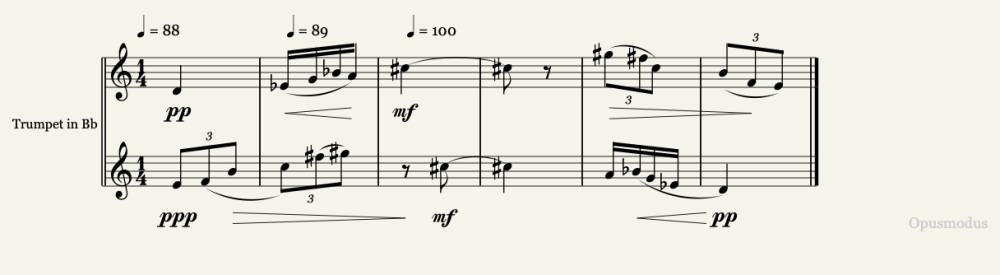
why does the trumpet and the piano part both "sended" and displayed as "trumpet", played only on channel 1 ? i do not understand what's my mistake... thanx for some help (def-instrument-set group1 :instruments (:group group1 :trumpet (:layout trumpet-layout :port 0 :channel 1 :sound 'gm-trumpet :pan (pan 0) :volume 92) :piano (:layout piano-layout :port 0 :channel 2 :sound 'gm-piano :pan (pan 10) :volume 92) :sine (:layout treble-layout :port 0 :channel 2 :sound 'gm :controllers nil :pan (pan -10) :volume 92) :noise (:layout treble-layout :port 0 :channel 2 :sound 'gm :controllers nil :pan (pan -5) :volume 92))) (midi-destinations) ;;;;;;;;;;;;;;;;;;;;;;;;;;;;;;;;;;;;;;;;;;;;;;;;;;; (setf p1 '(q d4 pp s eb4 < leg g4 < leg bb4 < leg a4 q. cs5 mf -e 3q gs5 > leg fs5 > leg c5 > b4 > leg f4 leg e4)) (ps 'group1 :trumpet p1 :piano (gen-retrograde p1) :output :midi :tempo '((88 1) (89 1) (100 1)) :time-signature '(1 4 10))
-
Hello, I have a MIDI file which I'm able to play fine in OpusModus. When I attempt to use File > Export > MIDI to score I receive the following error: "The operation couldn’t be completed. The value NIL is not of the expected type (OR CONS INTEGER)." I've tried a variety of export settings, all result in the same error. My goal is to import a score in some format (MIDI, MusicXML) and convert to OMN. Thank you, Tom
-
I can't figure it out how it works, it gives strange results here (see screeshot), I need some assistance.. Thanks! (midi-to-omn "~/Opusmodus/Media/MIDI/Bach/bach-gv-aria.mid" :instrument 1) gives what is seen on the screenshot

-
I payed for a personal version, but I don't see a serial number in any of the emails I received. I do see a transaction id in the email saying that you received payment. Where do I find the serial number to put into the registration box.