

JulioHerrlein
-
Posts
806 -
Joined
-
Last visited
Content Type
Forums
Events
Store
Video Gallery
Everything posted by JulioHerrlein
-
 Dear Friends, How to have multiple instances of Live Coding in Windows Machines ? I´m trying to make this happen even from different files, but the ps expression always open the live coding in the main navigator window. Thanks ! Happy 2024 ! (ps 'gm :afromenu1 (list (make-omn :pitch (gen-loop 120 (rnd-pick (integer-to-pitch (gen-integer -29 43))):seed 269615) :length (gen-repeat 120 '(s s)))) :tempo 80 :output :live-coding )
 -
In my humble opinion, you can do anything you can rationalize in terms of lists, functions and algorithms. That´s the basic concept. There are idiomatic, stylistic things that demands more revision due to its "not so automatic" nature. Some styles have a blend of automatic procedures and some touch of imprecise things. Maybe what I call "imprecise" here is somewhat of a higher order in terms of language, something that not depends necessarily in well formed lists or well formed syntax. Some of these high order language aspects can be captured by an AI trained with a specific idiomatic database based on common practice procedures for example. Or simply made manually case by case... Meaning is not captured by lists... Our cognition of form neither... Generating and juxtaposing materials does not create meaning. It´s a necessary step, but it´s not all... melodize and pitch-melodize are similar but not the same. Check the docs.
-
Old VSL .gig files...
-
The drop types are the same, independently of the chord family. It´s a matter of ordering the notes and keep the rule of no more than an octave between adjacent voices.
-
Opusmodus + SuperCollider in Windows ? Do you have a tutorial ? Best !
-
Beautiful ! Any chance to get the code ? Happy 2024, Stephane !
-
Thanks !
-
Thank you, David. I used many functions from Opusmodus in the piece ! Happy 2024 !
-
Thanks, Janusz !
-
Video about 5-note voicings with drop-voicing function (in portuguese)
-
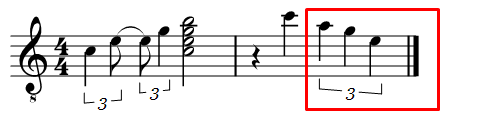
Interesting. Both the notations are correct, but I prefer the second most. The first could be achieved by (3h 3q tie 3q 3h). My solution in the moment was to change the time sig to 2/4 (then the triplets appeared right) and then changing back to 4/4 in musescore. Fortunately it was a simple thing... The problem is when you have multiple time signature changes and have to change all manually... Best !
-
Dear friends, How can I get my tuplets as the second way (all like the bar 2) ? The code is the same (3h), but yields different results... Thanks ! Julio ((3h c4 e4 g4 h c4e4g4b4 ) (-q q c5 3h a4 g4 e4))
-
Some differences in the new interface
JulioHerrlein replied to JulioHerrlein's topic in Support & Troubleshooting
Maybe using the windows file explorer to sort... -
Some differences in the new interface
JulioHerrlein replied to JulioHerrlein's topic in Support & Troubleshooting
Both sorting processes can be implemented. It´s common in every operational system, or file explorer. Best, Julio Sometimes, I take a vacancy from using Opusmodus and I have a hard time finding things... Actually, I´m a little crazy, but softwares are also supposed to help crazy people. -
Some differences in the new interface
JulioHerrlein replied to JulioHerrlein's topic in Support & Troubleshooting
Yes, I´m already doing it. But´s it´s a kind of weird hack... But sorting by date in all workspaces is still desirable... Thanks ! -
Some differences in the new interface
JulioHerrlein replied to JulioHerrlein's topic in Support & Troubleshooting
I´m using multiple workspace files. A good idea would be to have the possibility to sort the opmo files by date (recent to old and vice versa). Sometimes I have difficulty to find my files (I have too many...). But I´d like to find the ones I worked recently, so a good thing would be to sort by date. Is it possible ? Best, Julio -
Dear Etu, The midi works differently in Mac. Actually, Mac can share the midi drivers among different softwares. In Windows, once a midi driver is used by one application, it can´t be used by other application. So, I helped Janusz and the team of programmers to develop a different approach for Windows systems. With this option for selecting inputs and outputs, you can manage to map the midi inputs and outputs to match the best option for your system. For example, I have the hardware controllers input drivers going in the input of Reaper, that also hosts all my sound libraries and other VSTs. From Reaper I configured the output of just my little keyboard midi controller to input in Opusmodus, via the loopback software. In Mac you can map everything using the MIDI/Audio studio configuration inside OSX. All the best, Julio Herrlein
-
Julio Herrlein talks about Composition Process with Opusmodus at the 1st Opusmodus Convention.
-
In this video I will describe some of the techniques I used in my compositional process and why I decided to use OPUSMODUS Software for compose music ! Also my experience with Pure Data and Nodal Software before moving to Opusmodus.
-
This is a demonstrations of the MIDI ENTRY feature of Opusmodus Software, using a MIDI GUITAR CONTROLLER.
-
This is a composition for solo piano I did during my Doctorate studies using the concept of parametric composition and the opusmodus software. Opusmodus is amazing.
-
Dear All, I think there is a much needed basic function in Opusmodus: a function to perform diatonic transposition, like (pitch-transpose-to-set (1) '(c4 d4 e4) :set '(c4 major)) result: (d4 e4 f4) (pitch-transpose-to-set (2) '(c4 d4 e4) :set '(c4 major)) result: (e4 f4 g4) (pitch-transpose-to-set (1) '(c4 d4 e4) :set '(d4 major)) result: (cs4 e4 fs4) (pitch-transpose-to-set (2) '(c4 d4 e4) :set '(cs4 whole-tone) :round up) result: (cs4 ds4 f4) It could be also have the possibility of being octave independent in relation to the set, like (pitch-transpose-to-set (1) '(c2 d6 e5) :set '(c4 major) :octave-free t) result: (d2 e6 f5) Actually, the diatonic transposition (or transposition by any other set) is a more sophisticated thing than the simple transposition. And I think that is an essential function for music. I know that is possible to make it via tonality-map but I miss a more easier way to apply the idea over existing material. Best ! P.S. If this function already exist, please let me know.
-
Maybe this could be better addressed with AI. Actually, tonality is a very complex endeavour, a very idiomatic system. A melody can assume multiple functions. I like to think it as a system of scales with 9 different degrees or modal stations. Transposing this stations through the 12 keys is enough to get all the progressions of the common practice and jazz, a sort of George Russell stuff. Some time ago I build an Opusmodus library with chords, but after I realised that would be easier to just midi input the chords I like and process the voicings with the drop-voicing function I helped Janusz to create. Each composition have some unique and handmade stuff. For me, that part is the choice of pitches and underlying harmony. I have my sensibility based in years of hearing and playing. Probably the AI will bring some ease to the process, but as humans, we need time to grasp and really internalize the material. The same occur with Opusmodus output, that sometimes brings more material than we can deal with, in the process of building a piece. Part of the problem is also dealing with form and the cognitive aspect of the information flow. Best, Julio
-
How to rewrite example from book that uses omn-dictum
JulioHerrlein replied to jon's topic in OMN Lingo
Dear Cliff, I finished the book in October 2022. Now, it´s in the revision and translation stage, according to Marco and Janusz. Looking forward ! The plan is to release in the same publishing house of the first Opusmodus book. All the best ! Thanks for the interest. -
Assistant unable to load pdfs in windows version
JulioHerrlein replied to ludvig's topic in Pre Sales Questions
Try to install a FOXIT PDF reader (it´s free) and make it your default PDF reader. Hope it helps. /static/company/images/icons/foxitpdf.png Download de Leitor de PDF e Visualizador de PDF grátis | Foxit Software WWW.FOXIT.COM O melhor leitor e visualizador de PDF gratuito, usado por mais de 700 milhões de usuários. Foxit PDF Reader para Windows, Mac e muito mais. Uma rápida alternativa de leitor de PDF ao Adobe Reader.